Tag: Lenny Bruce

  • Kinison’s Friends Recall His More Compassionate Acts

    Kinison’s Friends Recall His More Compassionate Acts

    By Dennis McLellan
    TIMES STAFF WRITER
    Originally printed in The Los Angeles Times
    Wednesday, September 2, 1992

    Colleagues remember shock comic’s off-stage kindness. But the tribute they’ll tape in Anaheim won’t be syrupy

    Pacing the stage like the Pentecostal preacher he once was, Sam Kinison would work himself into a primal heat as he railed against homosexuals, AIDS victims, organized religion and one of the topics closest to his heart: Marriage.

    “Oh, Oh-h-h -h-h! Marriage is hell-l-l-l-l!” the twice-divorced comic would scream.

    With an infectious giggle and his signature banshee wail, Kinison soared into the public consciousness in the mid-’80s as the King of Shock Comedy. His detractors–and there were many–called him obscene, vitriolic and annoyingly loud. His fans–and they were legion–called him an innovator, a biting social commentator for whom no topic was taboo. Not the Crucifixion. Not sex. Not even necrophilia.

    When the 38-year-old comedian was killed in a head-on collision on his way to a show in Laughlin, Nev., in April, media reports referred to the wild stage persona and the equally wild personal life of the man who joked that his cocaine use was once so heavy he used a garden hose to inhale.

    But his friends, many of whom will be honoring the outlaw comic at a comedy tribute Thursday at the Celebrity Theatre in Anaheim, remember another Sam Kinison.

    “The partying is legendary, but there also is a side of him that was very sweet and loving, and he was very good to a lot of people,” said Richard Belzer, who first met Kinison in 1980.

    Scheduled to join Belzer on stage are Robin Williams, Rodney Dangerfield, Judy Tenuta, Carl LaBove, James Carrey and Pauly Shore. The show, which will include video clips of Kinison’s career, will be taped for a later TV broadcast on the Fox network.

    Tenuta, the accordion-playing, self-anointed Love Goddess who met Kinison in a Denver comedy club in 1985, joked that “we used to hang out cruising for chicks together, Sam and I.”

    “He was the most compassionate person I ever met in my life,” said LaBove, Kinison’s best friend and longtime opening act. “He was always there for me.”

    But don’t expect a stream of sugary testimonials Thursday night. According to Belzer, “The tribute is going to be a life-affirming thing rather than maudlin.”

    “There won’t be a lot of reminiscing,” said Bill Kinison, Sam’s brother and manager who is serving as executive producer of the show. “It will be kind of a ‘Heaven Can Wait’ type set with a lot of smoke and things like that. The story line is basically whether or not Sam makes it (to heaven).”

    That seems an altogether fitting premise for a tribute to the outlaw comic with the hell-bound persona. Yet despite Sam’s penchant for the sacrilegious on stage, Kinison said, his brother never lost his own faith.

    “He was a strong believer,” he said. “His unhappiness was with religion and never his commitment to God.” With a laugh, Kinison added, “I don’t know if you’re going to have a lot of Christians who are going to believe that.”

    Proceeds from the tribute, according to Kinison, will go to his brother’s estate. At the time of Sam’s death, Kinison said, he was nearly $1 million in debt. “After he died and I looked at the estate I thought, ‘Well, if you can die a million in debt, you can say you enjoyed life.’ “

    Kinison feels a comedy tribute is the kind his brother would have wanted. “And I think just about all the entertainers who are involved are involved because of the contribution he made. When I watched ‘Comic Relief’ this year, there was not only the (raw) language but the (controversial) viewpoints that you probably wouldn’t have seen on HBO or on television if it hadn’t been for Sam breaking down all the walls.”

    Bill Kinison believes his brother belongs in the same camp as such boundary-stretching predecessors as Lenny Bruce and Richard Pryor. “What he brought–and they also brought–is being totally honest on stage. Even to a fault. There’s a lot of people who would not have agreed with Sam’s views on things, but he was honest on stage about it.”

    Tenuta agreed.

    “He was dealing with his demons on stage,” she said. “It was really refreshing to see someone just sort of take issues by the horns and really go to the root of it. He was just very funny. And you never felt that there’s this structure of ‘joke,’ like it’s a newscast.”

    Says LaBove: “Sam was the first guy to bring that kind of everyday anger, that stress you have in a car, in a marriage–all that stuff–and just blowing it out.”

    LaBove remembers first meeting Kinison in Texas in 1979 when they both were starting out in stand-up at a legendary Houston club called the Comedy Workshop.

    From the start, LaBove said, “Sam always had the stage presence because he had come from the ministry. Even when he didn’t have great ideas, he was always interesting.”

    As for Kinison’s legendary use of drugs, LaBove said “he was repressed as a preacher’s kid and as a preacher he was someone people looked up to for spiritual guidance. He didn’t have a lot of opportunities to experiment. He started late in everything, so actually he was going through his teen-age years when he passed away.”

    LaBove was riding in a van with Bill Kinison behind Sam’s car when the pickup driven by a teen-ager who had been drinking slammed into the comedian’s Pontiac Trans-Am. Malika, Sam’s longtime girlfriend and wife of less than a week, was knocked unconscious.

    It was LaBove who held Kinison just before he died. At first, the comedian protested that he didn’t want to die. But as LaBove told The Times after the accident, Kinison paused as if listening to a voice from above. Then he said, “OK, OK, OK.” And then, softly and sweetly, he uttered a final “OK.”

    “At the time I knew in my soul it was the moment of death,” said LaBove, adding that he has since found a sense of peace from hearing Kinison’s final words. “I’ve watched my father pass away and other people pass away, and there is a moment where it seems someone comes to get you or you see something and it really relaxes you. When Sam’s moment came, it seemed like Sam listened.”

    LaBove said that preparing his six-minute portion of the tribute has been an emotional ordeal.

    “As far as I’m concerned, everybody else is the stars of the show; I’m his best friend.’ I’m actually going to use this spot as my last public goodby to Sam.”

    Speaking late last week, LaBove said that “at this point, I’ll either tell stories about a friendship the public didn’t see and tell those funny stories of things he did off stage–and actually just talking to him, just staring up. I want a powerful moment. He was a powerful friend.”

  • Tribute: Sam Kinison (1953-1992)

    Tribute: Sam Kinison (1953-1992)

    By David Wild
    Originally printed in Rolling Stone, Issue 631
    May 28th, 1992

    “SAM KINISON was absolutely fearless,” says Robin Williams. “He was like a comedy combination of Chuck Yeager and Evel Kneivel. Most people go to the edge and then stop. Not Sam. He’d see the edge and then just keep going. And I think that scream he was famous for was just the sound he made on the way down.”

    That love of the edge was the key to Kinison’s appeal. And his anguished primal scream was mote than a successful comic trademark; it was a rebel yell that shook both the sensitivities of the politically correct and the “just say no” proprieties of the Reaganites. At his best, the Pentecostal preacher turned slash-and-burn comedian managed to make bad taste somehow taste good. He may very well have paved the way for less gifted loudmouth comedians. But he was also, in the words of gonzo talk show host Howard Stern – a close friend and bad-boy conspirator – “the closest thing we has to our Lenny Bruce.” That voice was silenced on April 10th, when Kinison was killed at the age of thirty-eight in a car accident near Needles, California.

    The son of a preacher man, Kinison was raised in East Peoria, Illinois, and while still a teenager found himself in the family business, spending a few years as a traveling preacher. But as an associate told ROLLING STONE in 1989, “God wasn’t big enough for Sam to hang out with.” Soon enough, Kinison found his true calling. By the early Eighties, his hyper-insensitive stand-up was drawing crowds at L.A.’s Comedy Store. His material included darkly comic observations on such topics as religion, starvation in Ethiopia and marriage (he was twice divorced). “I guess they’re tough jokes,” Kinison said in 1986. “But there’s lots of things you either laugh or cry at. And you just can’t cry.”

    “There was no censor with Sam,” says Robin Williams, one of Kinison’s earliest supporters. “It was almost like he had nonstop Tourette’s syndrome. He couldn’t stop saying the things that everyone else might think but was afraid to say. I’ll never forget the time I saw him do five incredible minutes on the subject of sodomy and then a few minutes later had him introduce me to his mother. People sometimes forget how good he was and lump him in with Dice Clay, but Sam really had the stuff.”

    “He’ll definitely be remembered,” says Rodney Dangerfield, another early booster, “because someone that funny and that wild you don’t forget.”

    With his oversized Outlaws of Comedy entourage and his babushkaed Steven Tyler-meets-the-Muppets look, Kinison often seemed more like a rock star than a comedian. He packed large concert halls, sold hundreds of thousands of records, had a hit single with his version of “Wild Thing” and made the cover of ROLLING STONE in 1989. The video for “Wild Thing” showed Kinison cavorting with PTL scandal figure Jessica Hahn (with whom Kinison had a brief and stormy affair) and a cast of well-known hard rockers. Kinison embraced the hard-living, hard-rocking metal lifestyle and befriended many musicians. The members of Motley Crue released a statement that said, “If God didn’t have a sense of humor before, he does now.” Kinison was, according to many who knew him well, a warm, generous and at times childlike man with a spiritual streak. “He hated to even hear the word religion,” says Jessica Hahn, “but he was definitely a man who loved God. He had a cross inside the lining of that long coat he used to wear. It was no joke to him.”

    Ironically, Kinison seemed to be cleaning up his act in the end. He had joined Alcoholics Anonymous, apologized to gay groups for some of his controversial AIDS material and appeared on the Fox sitcom Charlie Hoover in an attempt to prove he could behave professionally. And just five days before his death, he had married his longtime girlfriend Malika Souiri.

    “Some people seem almost disappointed that Sam didn’t die from his excesses,” says Howard Stern. “Anyone who writes that guy off as the Fatty Arbuckle of the Eighties – some wild, partying maniac with zero talent – is just completely missing the point. He was a major talent with a brilliant comic mind. Sam’s bad night was a lot more interesting than just about anyone else’s best night.”

    “I usually don’t like having comedians on my show,” says Stern, “because they’re for the most part just personas, one shtick line after another. Sam was totally different – he was utterly real. I think if Sam had fucked his own sister, he would have called me on the ait the very next day to talk about it. And he would have made it funny, too. That sort of honesty got Sam in trouble, but it was also what made him incredible to listen to.”

    “Sam could always surprise you.” says Stern. “I remember one time he was on our show, and I’d gotten an earring, and he seemed to want one, too. I told him I’d go with him. And he said: ‘Oh, no, I can’t do that. My mother will kill me.’ I said, ‘You’re overweight, you’re and admitted alcoholic, you do all this cocaine, and you’re worried about what your mother will think of an earring?’ But he was dead serious.”

    “I’ve never seen a stronger human being,” Stern says. “Anyone else would have been dead from the way Sam carried on. I remember when he called right after an AA meeting to tell me how cool it was. He was so proud of the one-month chip they’d given him. Then a month later he’d show up with a one-day chip. But he was real proud of that chip. That’s why this is all such an irony. I always thought Sam would come to his senses and say enough is enough. And according to him brother Bill, he’d come to that conclusion in the end. It’s hard to know what direction Sam would have gone in, but whatever happened to him, he would have gotten a few more great hours of stand-up out of it. And now we’ll never know.”

  • Comedy Review: This Time Around, Kinison Isn’t Just All Bite and Bash

    Comedy Review: This Time Around, Kinison Isn’t Just All Bite and Bash

    By Mark Chalon Smith
    Originally printed in The Los Angeles Times
    Wednesday, April 25, 1990

    NEWPORT BEACH — Sam Kinison has long been assailed for his unyieldingly provocative material. Homosexuals say he’s anti-gay, women say he’s anti-female, some people say he’s anti-human. Lots of people just say he’s crude, rude and lewd.

    His detractors wouldn’t have been disappointed with his show at the Laff Stop Monday night. There was plenty of the stuff that gets him in trouble, and the close-up nature of the 280-seat club (Kinison usually plays to rock concert-size crowds) put his defiantly caustic side right in your face.

    But Kinison wasn’t all bite and bash at everybody else’s expense. You couldn’t call his 50-minute set charitable, by any means (for one thing, tickets were a stiff $25 a pop). But by Kinison standards, it was almost humane. He didn’t even scream that much.

    Dig this. Kinison at one point suggested that men be more tolerant of women and their distaste for certain sex acts (say what?). He also made something of an environmentalist’s plea for the dolphins (they should have an 800 telephone number, he said, to call for advice on how to avoid tuna), and he blasted drug-taking several times.

    Then he drew in on the Orange County angle with a bit about Walt Disney that began affectionately and touched on the values of “family entertainment.”

    Too much for you to assimilate? Actually, Kinison went on to describe himself as “family entertainment” (come again?) and ultimately confessed that he thinks Walt was a pretty weird dude. Any guy who made “Old Yeller” (“a very sick movie about a dog who has to be shot”) couldn’t be all good, Kinison opined.

    Some of his most accessible riffs had an impromptu edge. He dwelled on the National Enquirer and its many stories about his escapades. His favorite was the one linking him romantically with Lenny Bruce’s 83-year-old mother. Forget the print media, though. What really unnerves him is television, especially shopping channels and the new phenomenon of 30-minute commercials masquerading as news programs, usually hosted by “burnt-out actors like Robert Vaughn and John Davidson.” He used that as a springboard to condemn the invidious nature of TV, a recurring theme of the evening.

    As usual, though, gays had to endure the majority of his abuse, all of it unprintable. It’s this particular obsession of Kinison’s that has created his biggest problem: It raises the question of his comedy’s validity, certainly when it relates to sensitive issues, not just affecting gays but all groups of people.

    The thinking man’s defense of shock comedy, of course, is that by striking a subject with brutal humor, we remove the barriers of propriety and politeness that separate us from it. Once the topic is pounded home, there’s no avoiding it: The shock we’ll experience will be that of self-recognition.

    It’s hard to tell if that’s Kinison’s intent, or even if that’s what he accomplishes. What’s clear, though, is that he works up a catharsis in his fans (any guy who’s been done wrong by his girlfriend, for example, certainly can identify with Kinison’s rants).

    Does the linkage reinforce or defuse the negative feelings? That’s the conundrum of Sam Kinison.

  • Hate-Mongers Are a Sad Chapter in the History of Comedy

    Hate-Mongers Are a Sad Chapter in the History of Comedy

    By Randy Lewis
    Originally printed in The Los Angeles Times
    Sunday, April 22, 1990

    The most important comedians have always been those who helped knock down the social, racial, economic and/or cultural barriers that keep people apart.

    In the ’30s, Charlie Chaplin and the Marx Brothers made sure that society’s little tramps didn’t get steamrolled in America’s desperate quest for the better life. Though they worked from greatly different vantage points, Lenny Bruce and Bill Cosby contributed during the 1960s to the condemnation of culturally ingrained racism. And Woody Allen has built a career on giving hope to nerds throughout the world.

    Along the way, comedians often have assumed the role that the sage assigned to journalists–“to comfort the afflicted and to afflict the comfortable.”

    Unfortunately, some new-generation descendants of the greats have begun to worship the tools some of their forefathers used–stinging insults, graphic language, sexually explicit situations–without understanding the job for which those tools were employed. I refer to two of the today’s hottest stand-up comics, performers who have reached rock ‘n’ roll-star status capable of filling huge concert halls and arenas: Sam Kinison and Andrew (Dice) Clay.

    Each is scheduled to play Orange County this week: Kinison in a club date at the Laff Stop in Newport Beach and Clay at the 18,765-capacity Pacific Amphitheatre in Costa Mesa. (Sam usually does larger facilities, but he booked this one himself, reportedly to help pay his considerable alimony bills.)

    Both have captured the attention (I would have said “imagination,” but that’s far too complimentary) of the MTV-generation audience. Both appeal primarily to teen-aged males–no surprise, considering the heavily misogynist content of both their acts. If I were a woman and a date took me to see either of these wild boors, I’d ask for his money back–then hail a cab.

    Though I’m at a loss to explain the popularity of either, Clay is the bigger mystery. (By the way, if you’re looking for lots of examples of their “jokes” here, forget it. The amount of each man’s material that can be quoted in a family newspaper probably weighs less than a stegosaurus’s brain.)

    With Kinison, it’s easier to identify (if not identify with) the primal catharsis in some of his routines. On his first album, there was an underlying sense of true frustration at the hypocrisy he experienced in the life he led as a preacher before turning his back on the church and becoming the antichrist of stand-up.

    Also, Kinison, unlike Clay, knows how to structure a joke that is created out of a unique (albeit generally base) perspective. And Kinison knows how to deliver a punch line.

    One old routine about how difficult Jesus might have found it to explain his Crucifixion and Resurrection to a wife displayed originality, intellect and absurd juxtaposition of the real and the far-fetched. Sound comic principals, all.

    But since then, Kinison has been caught up in his own fame: He spends nearly as much time on his latest album responding to Rolling Stone comments about his reputed wild lifestyle as he does creating “new” material. And that consists of inflaming racist attitudes toward Iranians, gays, women, the physically disabled and just about anyone in the world who’s not Sam Kinison.

    Dice Clay, however, doesn’t even have that much going for him. How he has so quickly become a national phenomenon is a mystery that ranks up there with how TV execs ever thought Pat Sajak would one day unseat Johnny Carson.

    If there’s more than meets the eye to Clay’s act–a leather-jacketed New Yawk street thug who brags about every bizarre twist on intercourse he knows–I can’t find it. Clay substitutes unbridled repugnance for viewpoint, odious epithets for insight. He’s as funny as a gang rape, as clever as a midnight mugging.

    Lenny Bruce showed that comedy can be tough, brutal and sometimes even ugly in skewering the objects of his scorn. But those targets were small-mindedness, bigotry and hate–traits that Clay and Kinison would rather lionize. Their loathsome attacks on women, homosexuals, ethnic minorities and others aren’t pointed or thought-provoking. They are simply imbecilic. Perhaps Clay doesn’t make jokes about the chronically stupid because they would hit too close to home.

    If there’s any rationalization for Clay’s moronic-punk persona, it could only be that he really is a brilliant performance artist whose very presence exposes how easily America can fall in line behind a crude, unthinking, spectacularly unfunny delinquent.

    Could it be that both are so hugely popular for the simple reason that they accurately reflect, and give voice to, the values of their audience? That a young generation bred on the senseless brutality of slasher movies like “Friday the 13th” and “Nightmare on Elm Street” have become (to borrow Hunter S. Thompson’s pet phrase) a nation of swine?

    Is it possible that, because celebrity worship has been elevated to the rank of religious experience, we have surrendered the ability to think critically when in the presence of a “star”? Otherwise, why would audiences grant not just their approval but their delight at attitudes and behavior that, if expressed by a child or a stranger at the supermarket, they would greet with the back of a hand?

    More disturbing yet is the realization is that Kinison and Clay, because they are at the top of the stand-up comedy heap right now if only in terms of their ticket-selling potential, undoubtedly are spawning dozens, maybe hundreds of imitators who are dying to step into their dung-encrusted jackboots.

    Remember the scene in Woody Allen’s “Manhattan,” when a question–how does one respond to neo-Nazis–pops up at a posh party of left-wing intellectuals? “We should go down there,” Woody suggests, “get some bricks and some baseball bats and really explain things to them.” When one haughty woman opines: “Really biting satire is always better than physical force,” Woody retorts: “No, physical force is always better with Nazis.”

    But the best course of action simply may be the one you’d take with bratty children who misbehave just for the attention they can draw: ignore them and hope–no, pray–they’ll go away.

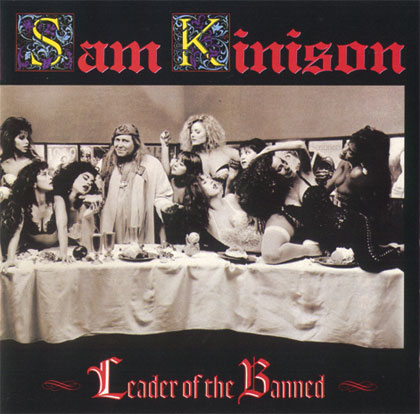
  • Leader of the Banned (1990)

    Leader of the Banned (1990)

    Sam Kinison - Leader of the Banned (1990)
    Sam Kinison – Leader of the Banned (1990)

    Sam Kinison’s third comedy album, released in 1990. Contains four cover songs.

    Side A

    1. “Detox This”
    2. “Shopping for Pets”
    3. “Sex, Videotape and Zoo Animals”
    4. “Jerry’s Bastard Kid”
    5. “Lenny Bruce’s Mom”
    6. “Casual Users of Terrorism”
    7. “Old People Must Die”
    8. “Grilled Cheese Sandwich”
    9. “Phone Call from Hell”
    10. “Gonna Raise Hell” (Cheap Trick cover)”
    11. “Mississippi Queen” (Mountain cover)
    12. “Under My Thumb” (The Rolling Stones cover)
    13. “Highway to Hell” (AC/DC cover)

    Resources

  • Why I Wear What I Wear: Sam Kinison, Tastefully

    Why I Wear What I Wear: Sam Kinison, Tastefully

    Originally printed in GQ
    June 1989

    Luckily, his wardrobe is more lighthearted than his humor

    HEY, KIDS! TRY THIS ONE AT HOME: Open all your doors and windows. Turn the volume on your stereo way up. Snap in a Sam Kinison comedy album, hit the “play” button and…

    “AAAAAAAWAAAARGH!!!”

    … get to meet many of your neighbors right away. Yessiree. Sam Kinison, that weird-looking, long-haired, overcoat-clad Prince of Public Obscenity, that Round Mound of Vituperation, tends to bring people together. Angry people. People who, for … some reason, take offense at his mega-decibel attacks on just about everybody. Last year, Warner Bros. Records took the unprecedented step of printing a public disclaimer – “THE MATERIAL ON THIS ALBUM DOES NOT REFLECT THE VIEWS OR OPINIONS OF WARNER RECORDS” – on the cover of Kinison’s live-concert album, Have You Seen Me Lately?

    What Warners just might have been worried about was Kinison’s onstage endorsement of misogyny (“I don’t worry about terrorism. I was married for TWO YEARS!!!!) and take on rock stars speaking out against drugs (“‘Rock Against Drugs’? Somebody must have been high when they came up with that title. It’s like ‘Christians Against Christ.’ Rock CREATED DRUGS!!!) and on drunk driving (“We don’t want to. You don’t get *&%$!!-ed up to see how well you do on the test later. But there’s not other way to get our *&%*!!! CAR BACK TO THE HOUSE!!!!”)

    There’s no doubt, however, that Warners is disclaiming Kinison’s remarks about gays and AIDS. “Heterosexuals die of it, too?” he asks rhetorically on the album. Then: “NAME ONE!!!!!!”

    To counterbalance this screed, the record company will be including information sheets about AIDS in future pressings of Kinison’s records. But it is too later to deflect the outrage that numerous gay and women’s groups have expressed over Kinison’s sense of humor.

    On the other hand, thousand of rabid fans – and a few critics, too – have shown admiration for Kinison. To them, his ear-splitting jokes are a sort of much-needed psychic Drano – and Kinison is a talented combination of Lenny Bruce, Ralph Kramden and Morton Downy Jr.

    And notably, nobody has accused Kinison of putting us on – of coming by his anger and alienation dishonestly. His own life story is too authentically bizarre for that: Born thirty-five years ago in Peoria, Illinois, Kinison was the rock-and-roll-loving son of an itinerant Pentecostal preacher. When he was 15, he was sent away to a Pentecostal seminary in upstate New York. After a year and a half, he managed to escape and spent the next couple of years on the road, a Seventies hippie drifter. That’s where he rediscovered God: During the next five years and one marriage, he resumed his former life and preached the Gospel on his travels throughout the Midwest.

    God canceled his management agreement in 1978, and Kinison moved to Los Angeles to break into comedy. For a while he was the doorman at the Comedy Store on Sunset Boulevard; late at night, when only the drunks were left, he’d refine his raging, primal-scream approach to comedy. Nothing much – except poverty – happened until 1985, when Rodney Dangerfield, an admirer, got him onto his HBO special. Then came the part of the deranged prof in Dangerfield’s Back To School. The the Letterman spots, the censored drug jokes on Saturday Night Live, the albums, the MTV guest-hosting, the nationwide tours, the house in Malibu, the lead role in the United Artists film Atuk – and the $5-million lawsuit UA filed against Kinison when it didn’t like either his rewrites of his attitude and shut down the production.

    Kinison was taking a much-needed break from arduous touring when freelance writer Andy Meisler visited him at a rented house overlooking the Chateau Marmont, famous site of John Belushi’s final check-out. There were a couple of surprises: The offstage Kinison, a good-humored host who gladly led an impressive tour through his overflowing closets, breaks into asterisks, ampersands and exclamation points only every few minutes or so; and those trademark overcoats, far from being thrift-shop castoffs, are actually $1,400 European-designer originals.

    “In the last couple of years, I guess I’ve spent six figures on clothes,” says the gnomish Kinison, not at all surprised that GQ has come to call. “I figure I spend a lot of time shopping. Eight to ten days a month, I go out and buy.”

    “Yeah, I guess you could say that I’s a real clothes whore.”

    I suppose the obvious question is: Do you have good taste in clothes? I think so. Especially for a large guy. I think i bring a little sense of fashion for fat guys, to be blunt. But it’s a different kind of look – an outlaw-runaway look. Half rock star, half modern kind of pirate. A modern-day bandit chieftain.

    Are you a loud dresser?

    No. No, I don’t think so. One reason is my size. It would stand out too much. And I don’t care for real loud clothes on men. I would say that about 80 percent of my wardrobe is black.

    Which fashion trend setters do you admire?

    Mostly rock stars, I guess. I’ve always thought of my comedy in terms of rock and roll. I think Sting is real sharp. I like the stuff he wears. Clapton is a very sharp dresser, too.

    When did you first start wearing your trademarks – those big overcoats and berets?

    Just before the first HBO special. What happened was that a guy named Tom Hedley – he wrote Flashdance, and came up with the ripped sweatshirt and all that – told me that [the overcoats] were going to be really big that fall. And I thought, Well, I can get a jump on all the other comics. It would be something people could identify me with.

    And now I love ’em. They’re like those dusters from the Old West. The Long Riders, you know? And as Rodney once told me, “Hey man, you never have to worry about what you’re going to wear.” I can show up in any condition, with just about anything on underneath, and throw on the long coat and the beret and do a show.

    I’ve basically kept up with one tradition: Everytime I do a television shot, I wear a different long coat. Now I’ve got about twenty, thirty of them hanging in my closet. I’ve got one from Kenzo. Another one’s from Harrods in London. I wore that one on my second Letterman shot. But it’s funny. After I wear them once in front of an audience, I don’t want to wear them anymore.

    The beret? That was something that women put me hip to a long time ago – which was, if your hair is messed up, wear a hat.

    That makes sense. But I noticed a lot of clothes in your closet that don’t exactly fit your image as a wild man.

    Oh, sure. I’ve got some suits by Nino Cerruti, and Bernini, and a tux by Pierre Cardin. I’ve got lots and lots of dress shirts. I like those shoes by Bally, and Capezio slippers. I’m also into short leather jackets that I can just pile myself into and wear around.

    Are your onstage and offstage wardrobes any different?

    Well, I really don’t wear the long coats much offstage. That sort of changes the look completely. Also, up there I wear ripped T-shirts a lot. There’s something about being able to tear up your clothes. After the show’s over, I just like to come backstage and – GRRRRR!- rip myself out of my clothes. It feel great.

    I guess it does. Have you always been this interested in clothes?

    Even when I was a kid. See, I was raised very poor, and I got into the idea of looking good in nice clothes. I really wanted to look nice and to have the finer things in life. To look “Hollywood” and really be somebody. That seemed more important to me than to the other people around.

    Which brings up your days as a preacher. What did you wear back then? Were you better dressed than your audience?

    Yeah. A minister is almost like an entertainer. It’s important that he be dressed up, really classy. Back then I had forty-five suits -conservative three-piece suits. Basically, that was all I wore. I was “Brother Kinison” from the time I woke up to the time I went to bed.

    And it felt good. It made me feel like an executive. Like, “Hey, I’m doing something important here.”

    That reminds me: I noticed some conventional suits in your closet. Some Perry Ellis, some Ungaro. Where would you wear those suits these days?

    Oh, to a business meeting. If I was going to meet with my manager or with my lawyer. If I was going to be sued by United Artists… FOR FIVE MILLION DOLLARS!!!

    I detect a bit of hostility. Are you a hostile guy? Do you not like women , for instance?

    Like women? I &n$*!! love women. I’m just tormented by them like everybody else. For some reason the image gets interpreted as misogynic, but it’s not.

    I mean – somebody who doesn’t like women doesn’t go shopping for them, that’s for sure.

    You mean you buy clothes for your girlfriends?

    Sure. My girlfriends get bored every couple of weeks, and you have to buy them new clothes and stuff. I just go down to the stove and have them show me three or four ensembles, and they pick out what they want out of those.

    have any of your girlfriends ever tried to change your look?

    No, because I wouldn’t have listened.

    How would they dress you if they could?

    Oh, God. Probably big $%&*$ sweaters and some corduroy pants. Those big oversized shirts. I don’t know.

    Sounds awful.

    Yeah. But what else would they pick out for you? They go, “This is nice.”

    “Nice” is not exactly the word. But one more question: What do you wear when you don’t want to be recognized?

    That’s a problem. Sometimes I try something bland, like a jogging outfit. And I wear sunglasses, and a big hat. But I don’t know. Maybe it’s my size, the hair, the shape of my face. But people just look at me and see right through it.

    I’m walking down the street and people shout, “Oh! Oh! Oh!” Then I just say, “$&%**! it. I’m dead.”